SOTA on Paper, Question Marks in the Lab: How Far Is AI Antibody Design from Preclinical Development?
Read the original on WeChat
Why does everyone else's AI antibody design success rate keep hitting record highs while yours stays painfully low?
When every reported result is independently reproduced and every experiment is rerun by a third party under standardized conditions, do the same success rates still hold up? And going a step further, can the binding hits reported in earlier papers still stand up to scrutiny?
With those questions in mind, Spiritein first retested 107 sequences previously reported to bind their targets; fewer than 30% passed validation. The company then used a range of open-source AI methods to design 1.16 million nanobody sequences and selected more than 300 candidates for wet-lab testing. Fewer than 5% of the 221 designs targeting IL-7Rα tested positive, while none of the 105 designs targeting PD-L1 yielded a binding hit.
Amid a boom in global protein-design competitions, we put AI-designed antibodies through a single, standardized experimental pipeline from start to finish.
Which reported results hold up under independent experimental validation?
Let's find out.
01 Two Competitions Put AI Protein Design on Trial in the Wet Lab
In recent years, AI protein design has rapidly moved into the industry mainstream. On both sides of the Pacific, two large-scale AI protein-design challenges were launched back to back.
On one side, Anthropic partnered with Adaptyv Bio to run a competition that solicited AI designs across five targets, with wet-lab validation for 5,000 proteins plus computational support.
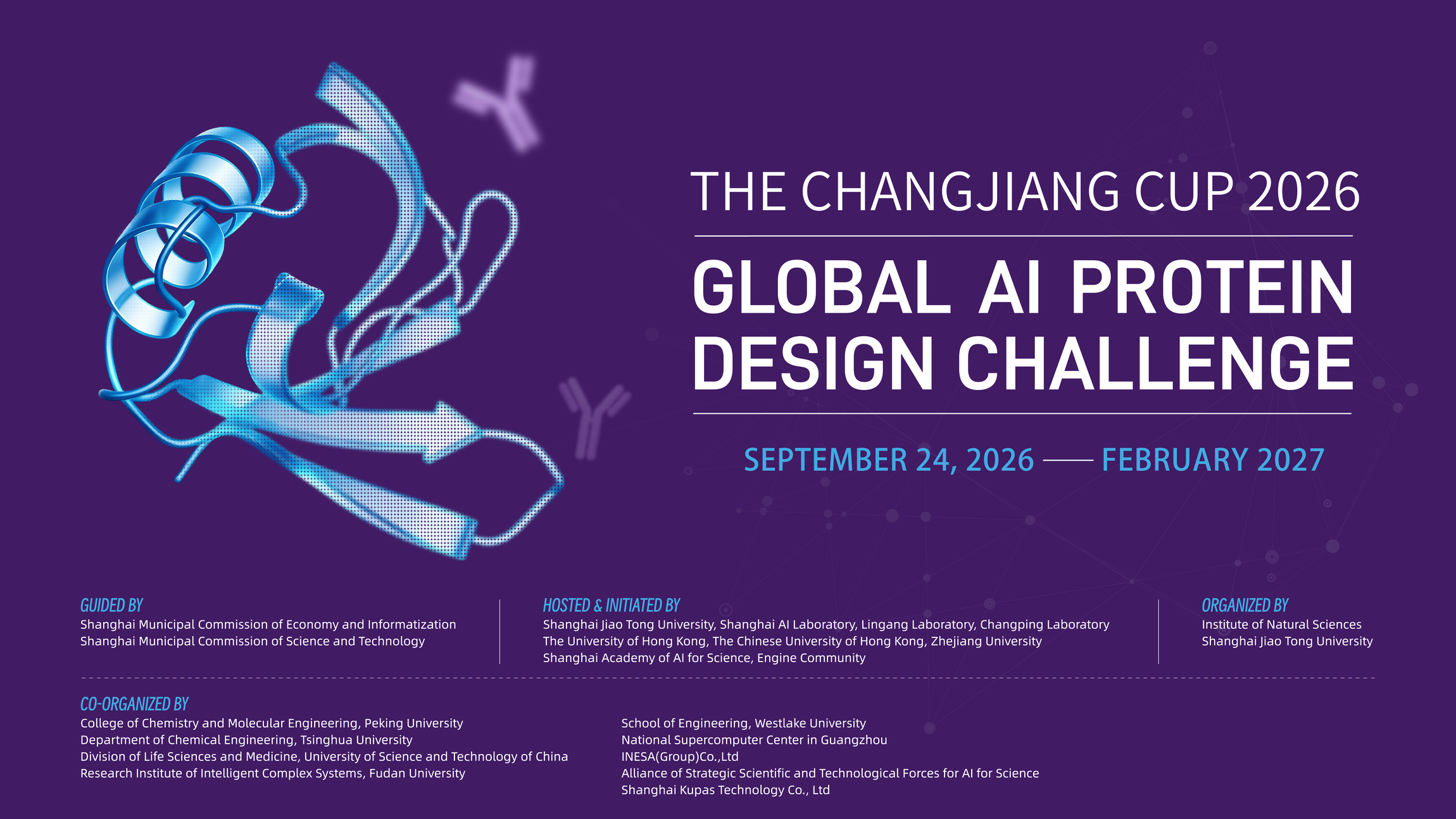
On the other, Shanghai launched The Changjiang Cup 2026 Global AI Protein Design Challenge, comprising seven tracks and offering wet-lab validation for 7,000 candidate sequences.
The two events signal a shift: the evaluation of AI-designed molecules is moving from "how closely the predicted structure resembles the real thing" toward the harder standard of whether the molecule can bind its target and show drug-development potential.
02 From AI Design to Preclinical: How Wide Is the Gap?
As a sponsor of the Changjiang Cup, Spiritein was asking the same question: how close are AI-designed antibodies to actually entering preclinical research?
Drawing on both the published literature and our own retest data, we take stock across three dimensions—target fit, binding activity, and developability—and frame the answer around three questions.
Question 1: Can the high affinities reported for AI-designed antibodies be reproduced in third-party experiments?
The KD values on leaderboards mostly come from self-selected targets and in-house pipelines. The real dividing line is whether they hold up in a different laboratory and assay system.
Question 2: If an AI-designed antibody has affinity, does it have developability?
Binding is only the price of admission; beyond it lies a whole series of hurdles — kinetics, specificity, stability, immunogenicity, and more.
Question 3: On mature targets that already have approved antibody drugs, can AI-designed antibodies deliver reliable hits?
For targets that conventional antibody R&D has already explored thoroughly, can current AI methods, within a clearly defined design-and-screening pipeline, produce binding molecules that stand up to experimental validation?
03 After Binding: Fewer Than 30% of 107 Published Binding Sequences Passed Retesting
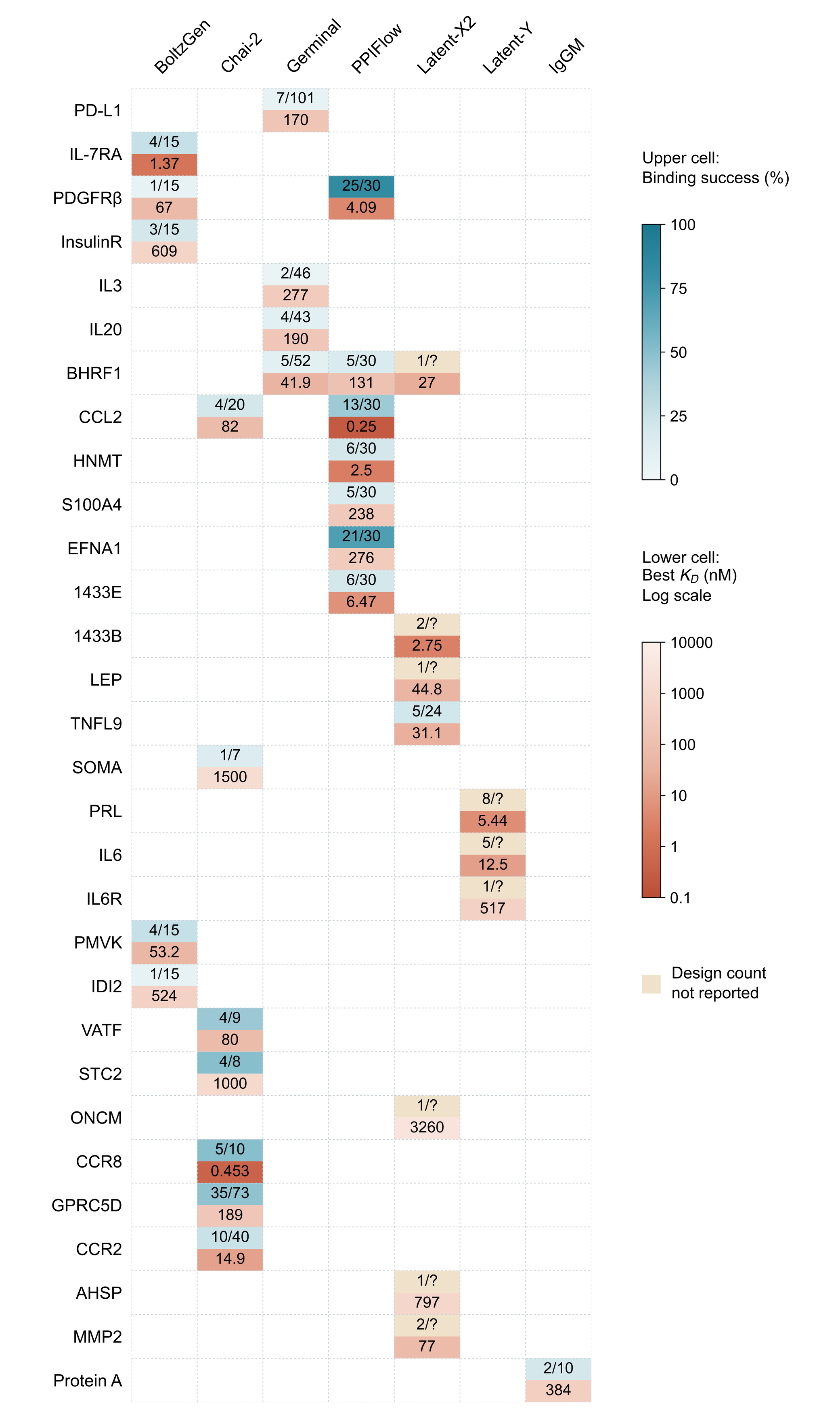
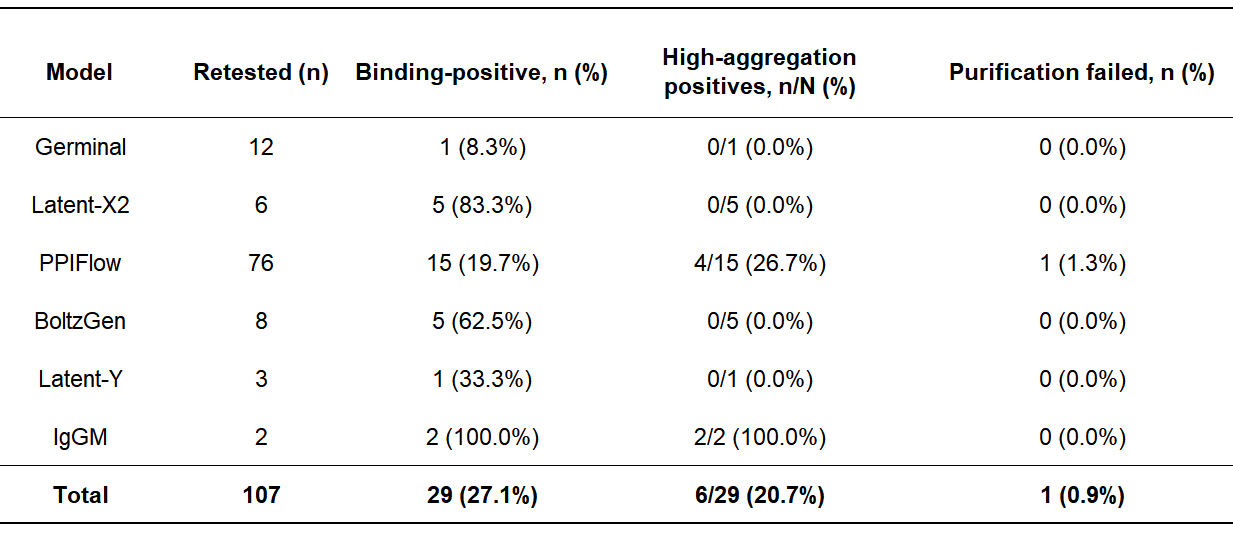
We retested all 107 sequences reported in the literature and added developability assays for each. Unfortunately, some molecules reported in the literature as having high affinity showed no detectable binding signal under our standardized conditions, even at a concentration of 2 μM.
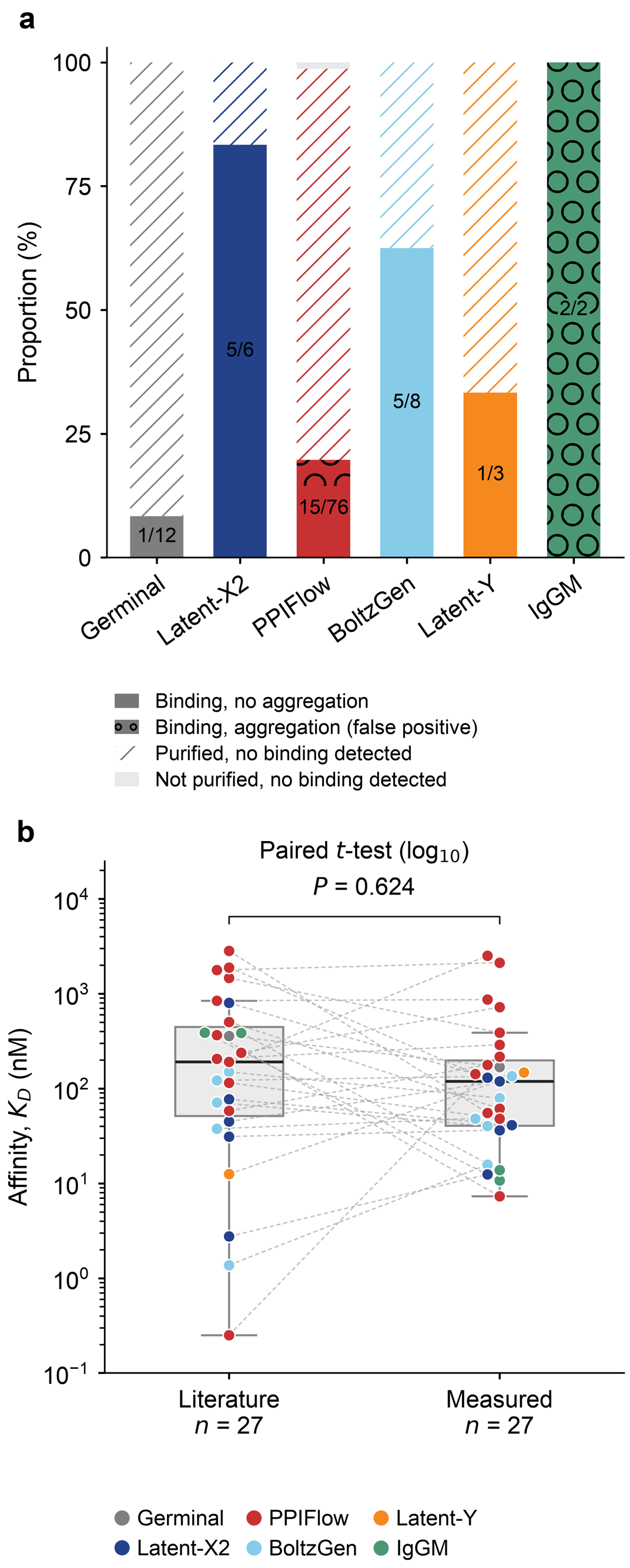
Of the 107 sequences, 29 ultimately showed binding, putting the overall retest hit rate at just 27.1%. Among the 27 sequences with paired KD measurements, we found no significant overall difference between the published and measured values. Yet between a published sequence and a reproducible binding event lies the unavoidable hurdle of standardized expression, purification, and characterization.
For candidates confirmed to have target-binding activity, we additionally measured their melting temperature and aggregation temperature to assess thermal stability and the tendency to aggregate upon heating. We also tested candidates’ binding to baculovirus particles (BVP) as an in vitro indicator of non-specific binding.
Overall, the melting and aggregation temperatures of the retest-positive molecules spanned a wide range, and a few samples showed notably high BVP signals. This shows that even once binding is achieved, developability gaps remain: high stability, aggregation resistance, and specificity are still an uphill battle.
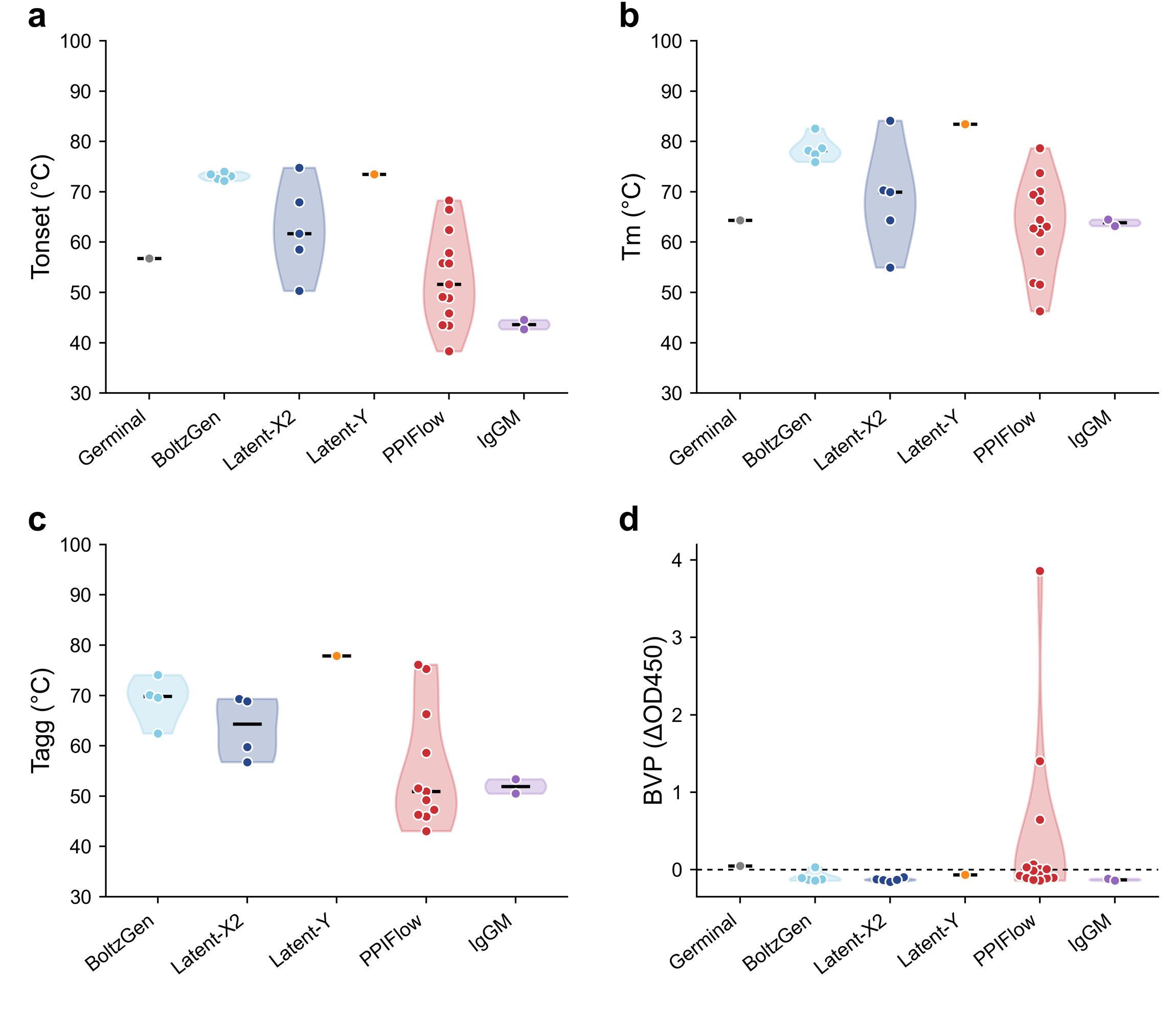
This points to the gap beyond binding: the goal of AI antibody design is not just to make something that binds, but to meet the developability criteria required for further development. Next, we turn to specific targets and models to see how these gaps play out in real sequences.
04 Round One: IL-7Rα Benchmark: BoltzGen Edges Ahead
To compare different models fairly, we fixed one target and put every method through the same pipeline. By this point we had identified two categories of tools: structure-generation models with native nanobody design support, and the inverse-folding (sequence-design) methods commonly used in protein design.
We chose IL-7Rα as the first benchmark task, pairing the four structure-generation models—BoltzGen, RFantibody, PPIFlow, and IgGM—with the three sequence-design methods ProteinMPNN, SolubleMPNN, and AntiB-MPNN to form 12 pairings. BoltzGen also offers a built-in sequence-design module; we added that route as well, bringing the total to 13 design combinations.
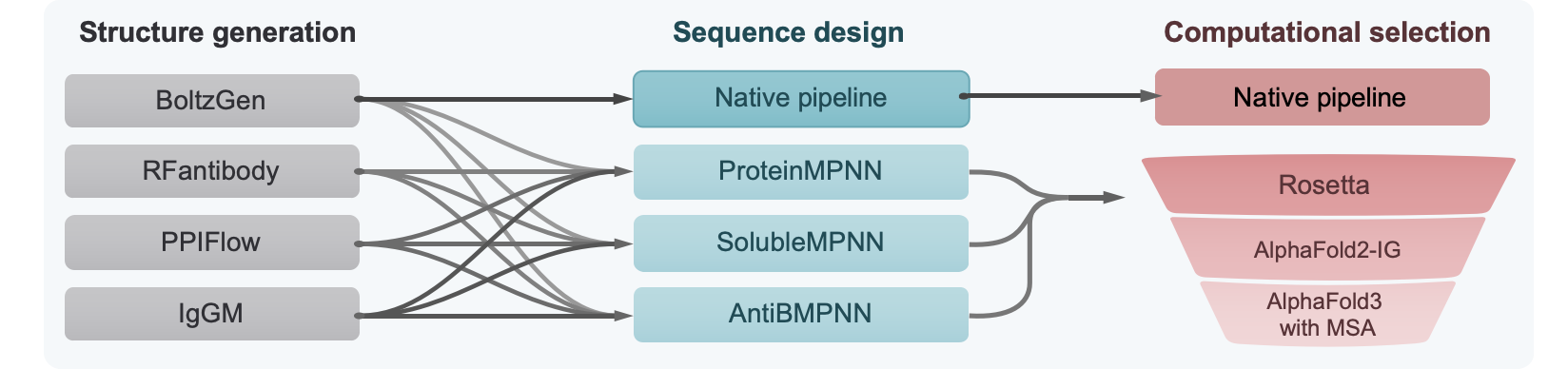
The 13 combinations generated roughly 960,000 nanobody sequences. Every candidate went through a standardized computational screening pipeline, including Rosetta energy evaluation, AlphaFold2-IG interface scoring, and AlphaFold3 complex-confidence scoring, and was ultimately ranked by the AlphaFold3 ipTM score.
The plan was to select the top 20 candidates from each combination for wet-lab validation. Notably, not every method could produce enough qualified candidates: for example, IgGM-generated sequences had a low pass rate in early screening, and some combinations fell short of the planned 20.
In the end, the team selected 221 nanobodies and sent them to a third-party CRO for wet-lab validation.
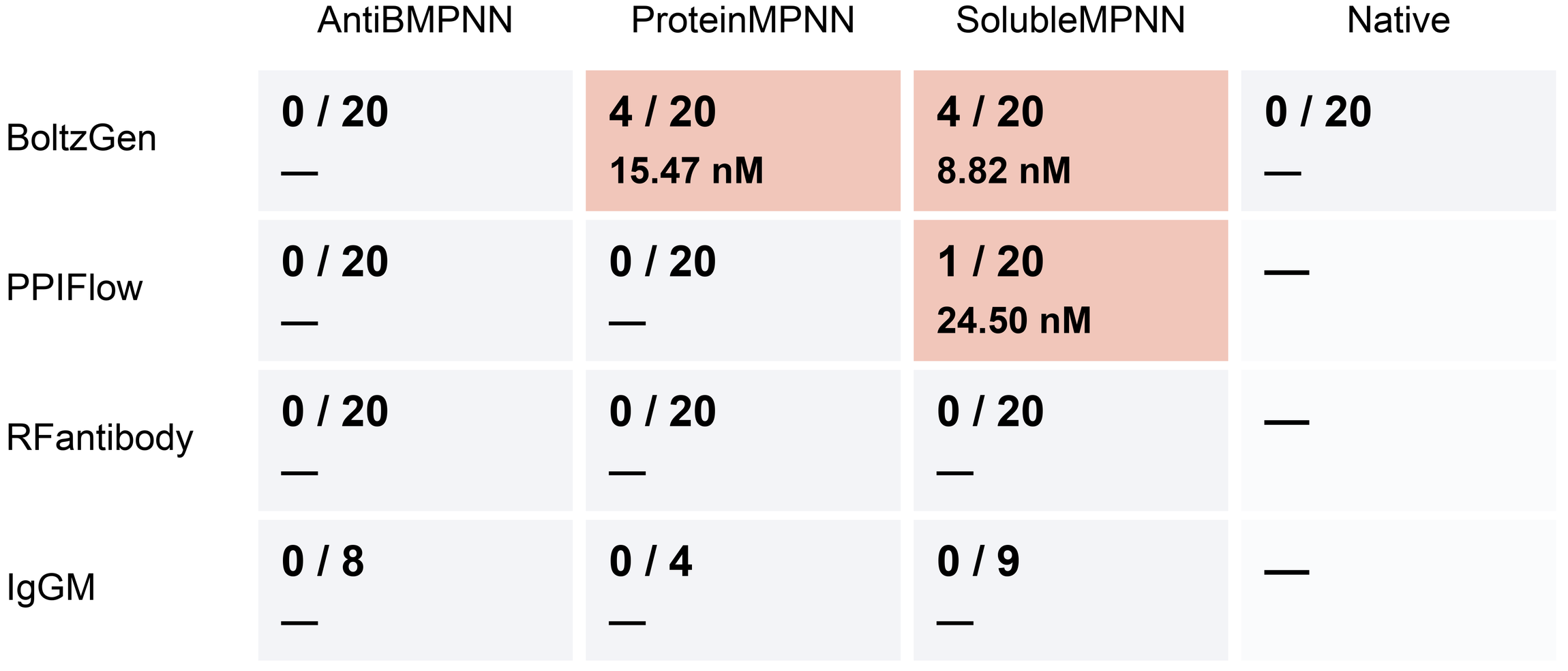
The scorecard from this round was bleak: the AI methods posted a hit rate of only 4.1%. Of the nine positives, eight came from BoltzGen's pairings with ProteinMPNN and SolubleMPNN (best KD 8.82 nM), with each route yielding 4 hits out of 20; the remaining one came from PPIFlow with SolubleMPNN (best KD 24.50 nM).
05 Round Two: The Mature Target PD-L1, Zero Hits Across Four Routes
PD-L1 is a mature target that has been thoroughly studied in conventional antibody R&D and already has several approved drugs. PD-1/PD-L1 inhibitors have produced some of oncology's biggest success stories. Blocking monoclonal antibodies can restore the body’s anti-tumor immune response by relieving PD-L1-mediated inhibition of T cells, and they are now widely used across solid tumors including non-small cell lung cancer, hepatocellular carcinoma, and urothelial carcinoma. As of 2026, more than 20 PD-1/PD-L1 inhibitors have received marketing approval worldwide.
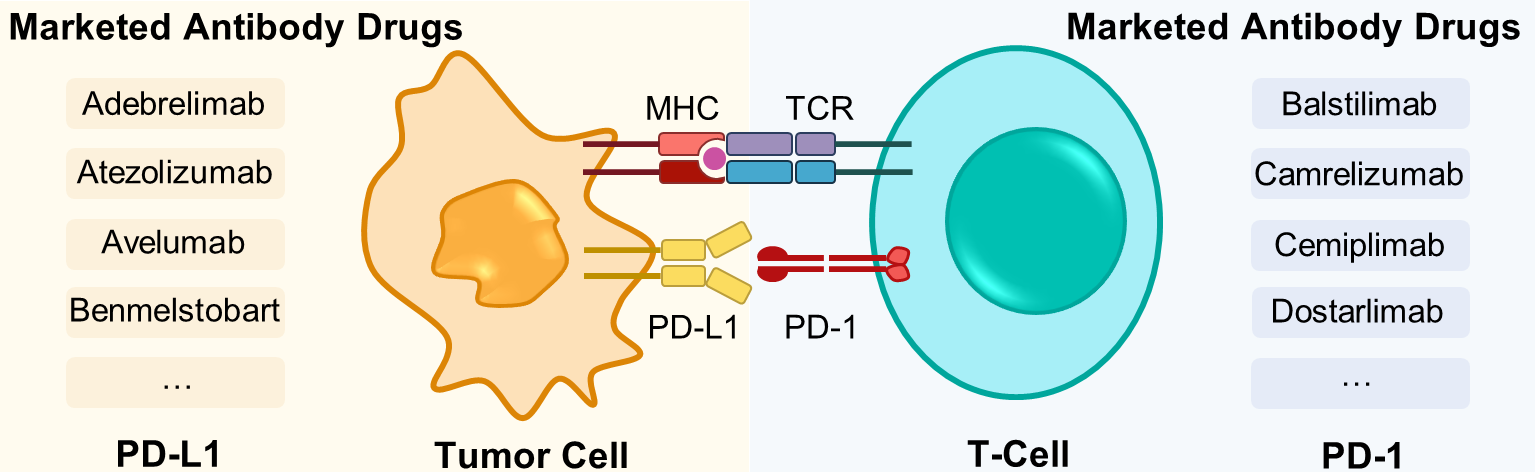
In this round, we evaluated four design workflows under a standardized protocol: BoltzGen, Germinal, OpenDDE-harness, and HalluDesign. Although nearly all antibodies from the four methods were successfully expressed and purified, none tested positive for target binding.
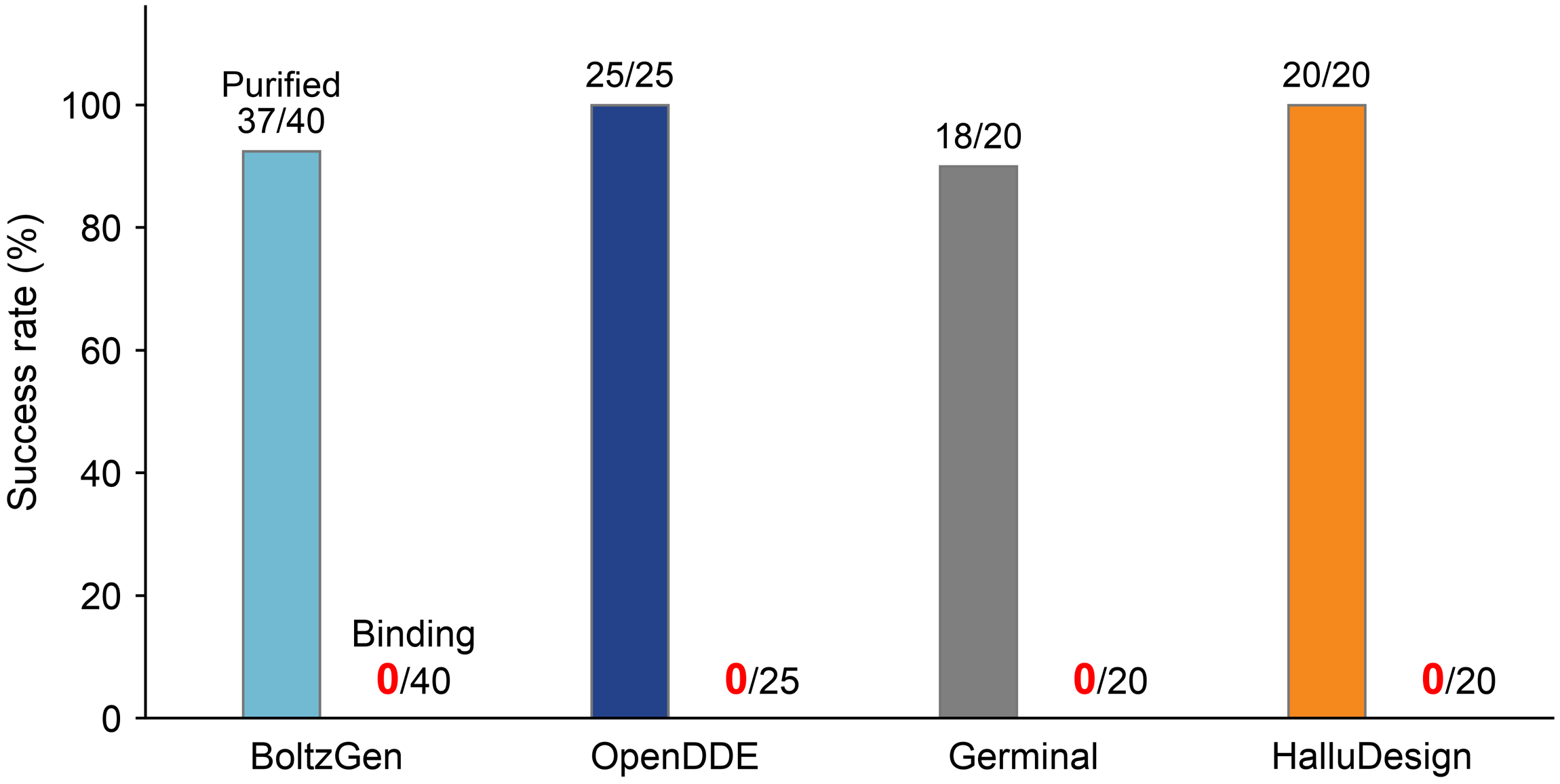
On a mature target that conventional antibody R&D has repeatedly validated and that already has several approved drugs, all four AI design routes failed to produce any detectable binding hits — including Germinal, which had previously reported positive designs.
The result is underwhelming.
For AI antibody drug design, an occasional hit is only the starting point; models still lack the ability to reliably generate candidate molecules that bind in experiments and to identify them before synthesis.
06 Three Conclusions
Drawing on all the data above, our judgment is this: these zero hits are not a fluke of a single experiment, but evidence of a systematic gap in current methods across kinetics, developability, and target fit.
Mapped back to the three questions in Section 02, the conclusions are as follows.
On Question 1: Some previously reported high-affinity results could not be reproduced under this round's testing conditions.
Of the 107 sequences reported in the literature, 78 showed no detectable binding upon retesting, even at a concentration of 2 μM. These findings highlight a substantial discrepancy between published reports of high-affinity binding and the results of our independent retesting.
On Question 2: AI-designed antibodies still have a long way to go before they become preclinical candidates.
Binding activity is only the first hurdle. Even when kon/koff kinetics and developability are taken into account, most AI designs still clearly lag the benchmark antibodies generated through conventional animal immunization and other routes, including antibodies disclosed in patents. The gaps exposed in wet-lab retesting are larger than those presented in papers and leaderboards.
On Question 3: AI methods fare poorly on many targets with well-established antibody-development pathways.
The ability of open-source models to generate nanoantibodies falls well short of expectations. In the PD-L1 assessment, the hype around AI de novo design methods was laid bare. The predicted performance on leaderboards has not yet translated into reproducible binding hits in the laboratory.
All code, workflow data, and raw experimental data from this assessment will be published on AbGround, the AI antibody-design benchmark platform we have built (link: https://spiritein.com/en). We will keep AbGround continuously updated with new retest and experimental data, and share subsequent results through public reports and collaboration channels. We also look forward to the wet-lab data the two competitions will release in due course, which will help the entire industry calibrate the true capability boundaries of AI models.
About Spiritein
Spiritein is a data-platform company focused on AI for bioscience. We use objective metrics to assess the protein-design capabilities of AI models, produce and publish data spanning AI design through wet-lab testing, and keep updating our benchmarks to support subsequent preclinical research.
The company was incubated by the Institute of Natural Sciences at Shanghai Jiao Tong University. Its founder, Yuanxi Yu, is a PhD graduate of the Zhiyuan Honors Program at Shanghai Jiao Tong University and a recipient of Shanghai’s "Super Postdoc" fellowship.
The company uses evaluation to set the yardstick and data to lay the foundation, helping users choose the right models and reduce the cost of trial and error. Through multidimensional assessment covering target affinity, developability, and more, Spiritein further connects model evaluation with drug development, driving AI protein design from "high model scores" toward "clinical translation."